This matters if you are a buyer trying to pursue one of these homes. It matters even more if you are an owner thinking about the next chapter of your life and wondering what a sale might look like.
This piece is an attempt to explain the actual mechanics of how Medina's waterfront inventory trades, and what that means for both sides of the transaction.
The supply side is smaller than most people think
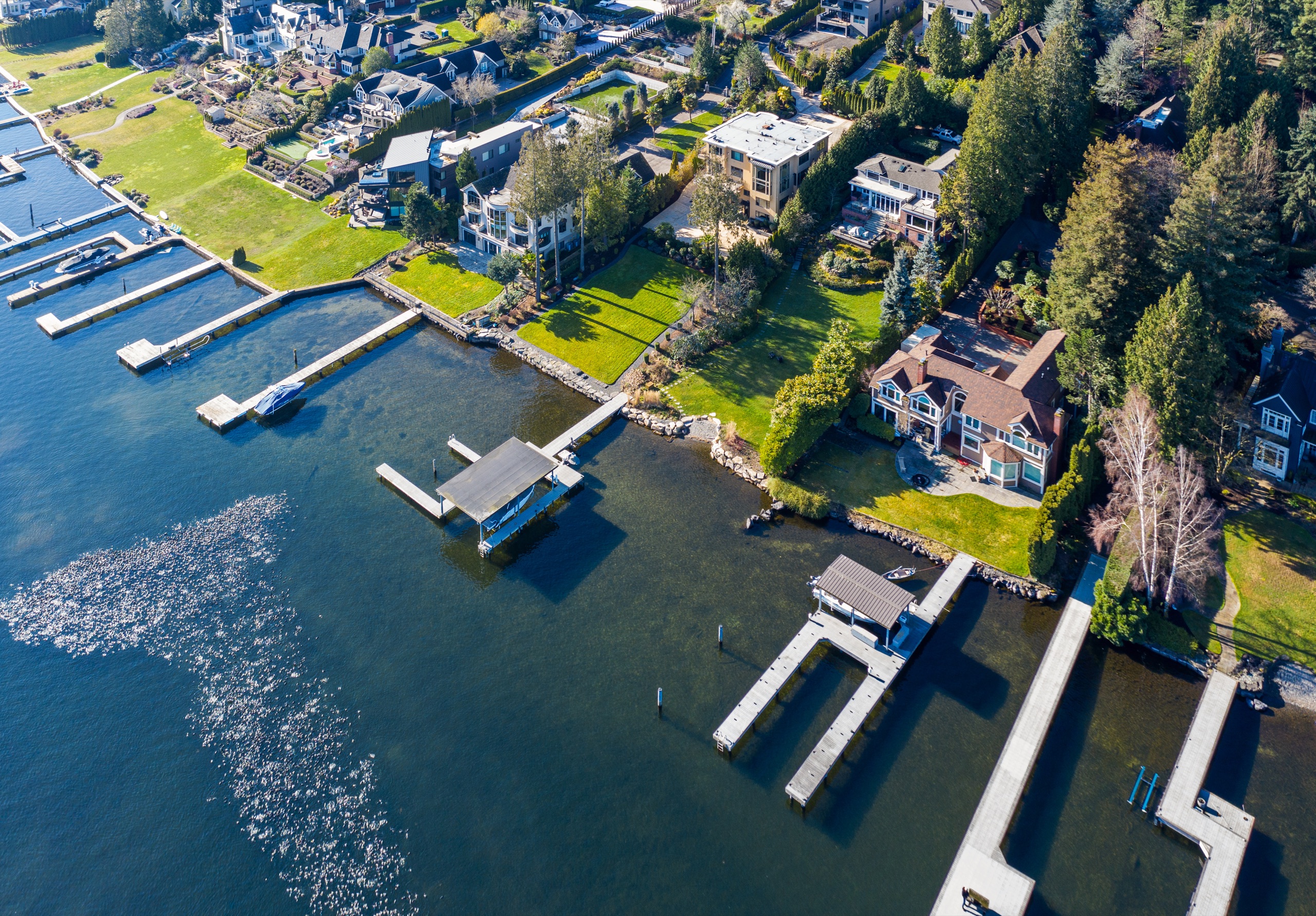
Medina sits on roughly 1.4 square miles of peninsula between Meydenbauer Bay and Fairweather Bay, with 4.5 miles of Lake Washington waterfront, nearly all of it privately owned, per the City of Medina Comprehensive Plan. That shoreline divides among three distinct corridors: Evergreen Point (the western tip), the Meydenbauer corridor (southern exposure), and Fairweather Bay (the quieter northern shore).
The total inventory of genuine waterfront parcels across all three is approximately 180 homes, give or take a handful depending on how you count properties with dedicated shared access versus direct frontage. In a typical year, between five and twelve of those parcels change hands. Some years it is fewer. The active on-market count on any given day is often zero.
Contrast this to Bellevue proper, where hundreds of waterfront-adjacent homes turn over annually, and you begin to see why Medina's market functions differently. It is not a market in the usual sense. It is a set of rarely offered positions.
Why owners stay longer than you would expect
The second dynamic is tenure. The average length of ownership for a Medina waterfront estate is substantially longer than the broader Puget Sound luxury market. Several factors reinforce this:
Generational transfer
A meaningful share of Medina waterfront homes transfer within families. Estate planning structures, LLCs, and trust instruments move these assets between generations without ever touching the open market.
Tax posture
The Washington state capital gains tax introduced in 2022, combined with federal capital gains on appreciated assets, creates meaningful friction for owners who have held a home for twenty or more years. A family that paid three million dollars for a Medina waterfront estate in 2002 and would realize twenty-five million today faces a tax bill that often leads them to defer the sale, explore a 1031 exchange (complex for a primary residence), or simply pass the home through estate.
Scarcity of comparable next homes
When a Medina owner does decide to sell, the natural question is: what next? For many owners, there is no obvious Medina-to-Medina trade available at their timing. A traditional upsize or downsize may require leaving the community entirely. That reluctance shows up as longer tenure.
Cultural gravity
Medina's owners tend to be connected to each other through schools, clubs, philanthropy, and business. A decision to leave is socially as well as financially material.
How the inventory actually moves when it moves
Because Medina's waterfront inventory is tightly held and infrequently offered, the typical owner who does decide to sell has options that are not widely available in the broader market. A sale can be prepared over an eighteen to thirty-six month horizon, with the home positioned architecturally, photographed at editorial quality, and the buyer pool cultivated quietly before any public marketing.
In Washington state, the legal framework for marketing real estate is clear. When a property is publicly marketed, it must be submitted to the appropriate MLS per the Clear Cooperation Policy and the rules of the Northwest Multiple Listing Service. This is not optional. Any sale of Medina waterfront through the licensed channels will ultimately appear on MLS.
What does vary is how the preparation and the initial outreach are handled, how the buyer pool is developed, and how the sale is staged through the process. A significant Medina estate sold well is not sold in a week. It is often sold over a season, with a deliberate and compliant rhythm.

What this means if you are a buyer
A buyer pursuing Medina waterfront needs to operate on a longer time horizon than they would anywhere else in the Puget Sound region. The active on-market inventory at any moment is usually zero or one parcel. The right home may not appear for months or years.
The buyers who succeed in this environment have three things in common. First, they have a precise brief. They know which corridor, which lot sizes, which exposures, which architectural preferences. Second, they have patience. They can wait for the right opportunity rather than compromising on a less-aligned property. Third, they have representation that has been watching the market for years and has relationships with the owners, advisors, attorneys, and architects who know what is happening before it becomes public.
If you are early in this process, the first useful step is a written brief. The second is a conversation with an advisor who works this inventory.
What this means if you are a seller
If you own a Medina waterfront home and are beginning to consider the next chapter, the single most valuable decision is to start the conversation early. Twelve to thirty-six months is a typical runway for a well-prepared sale. That time is used for architectural documentation, proper valuation, editorial photography, and the quiet development of the right context for a launch.
The difference between a home that sells for its full potential and one that leaves value on the table is almost always visible in the preparation, not in the final marketing burst. A significant Medina estate that launches with the right positioning tends to close at the top of its comparable range. One that launches underprepared often sits, stales, and eventually sells below potential.
Close
Medina's waterfront is not a market that rewards improvisation. It rewards patience on the buy side and preparation on the sell side. If you are considering either, the right starting point is a candid conversation.