Community Guide
Hunts Point
Fewer than 500 residents. One road in. A private security patrol. The most intentionally exclusive residential peninsula on Lake Washington.
Fewer than 500 residents. One road in. A private security patrol. The most intentionally exclusive residential peninsula on Lake Washington.
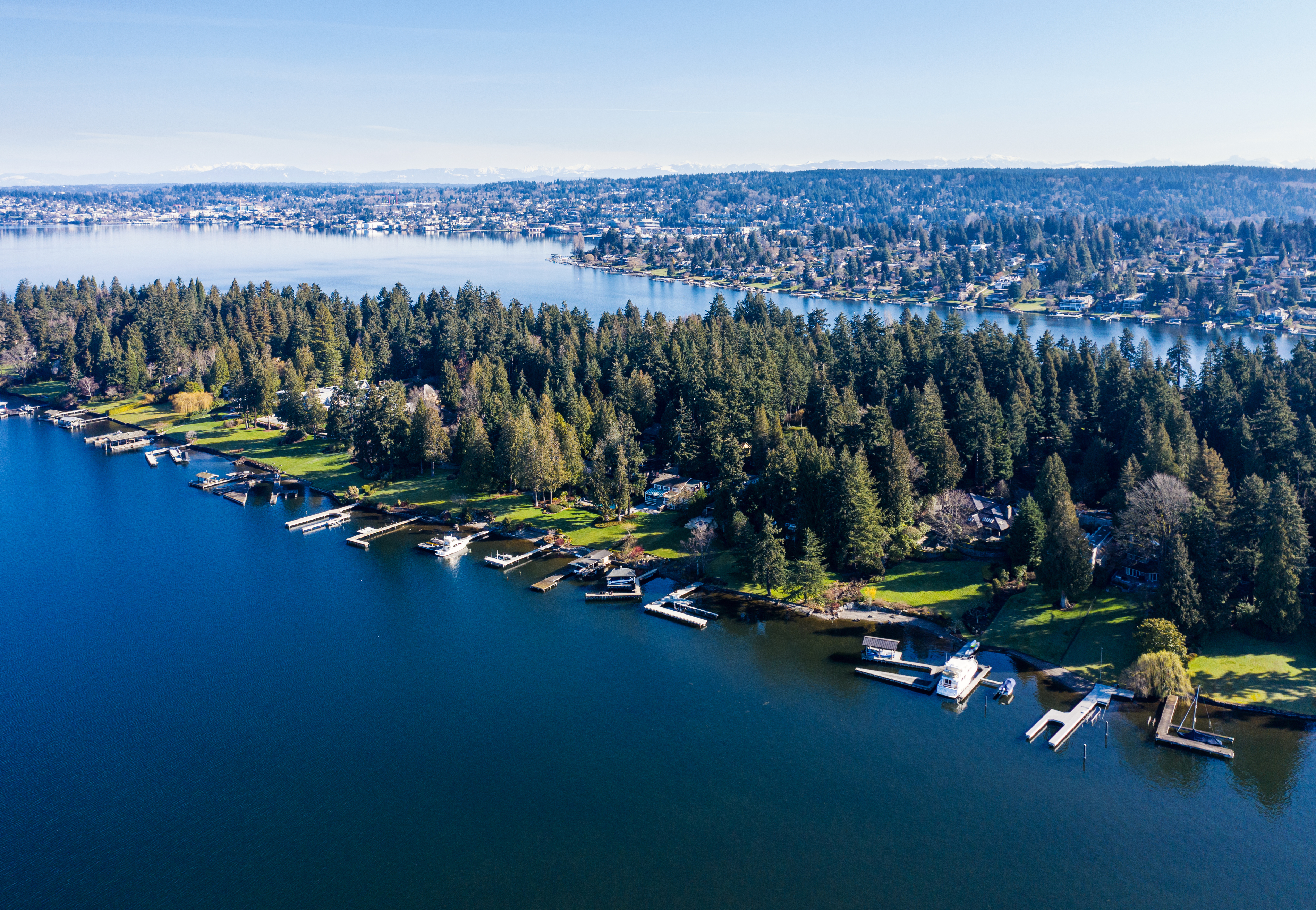
Hunts Point is, by every measurable dimension, the most restricted residential community in Washington State. A peninsula that extends roughly half a mile into the northern reach of Lake Washington, it is connected to the mainland by a single road, Hunts Point Road, that serves as both artery and barrier. There are approximately 200 homes. There is no commercial activity of any kind. A private security patrol, funded by the town's residents, monitors the single entrance and patrols the perimeter roads 24 hours a day.
These facts are well known, at least in outline. What is less understood, even among experienced Eastside agents, is how the community's physical structure shapes the market. Hunts Point's lots are, on average, the largest of any Eastside community, many between one and three acres, several exceeding five. The waterfront parcels, which wrap nearly the entire perimeter of the peninsula, include some of the deepest setbacks from the ordinary high-water mark on Lake Washington, allowing for lawns, gardens, and structures that extend to the water's edge in a way that regulatory constraints have made impossible in neighboring communities.
The consequence is that Hunts Point properties offer a scale of estate living that is genuinely rare in an urban metropolitan area of five million people. These are not large homes on small lots. They are compounds, with guest houses, sport courts, pool complexes, and deep-water docks, set within landscapes that were designed, in many cases, by the Pacific Northwest's leading landscape architects over the past three decades.
"Hunts Point is not a neighborhood you move to. It is a community you are invited into, by proximity, by patience, and by demonstrating that you understand what living here means."
With approximately 200 homes and annual turnover that rarely exceeds five to eight transactions, Hunts Point is not a market in the conventional sense. There is no meaningful inventory curve, no seasonal pattern, and no reliable comparable-sales methodology. Pricing is determined by a combination of lot size, waterfront footage, view orientation, and the condition and vintage of the improvements, but ultimately, it is negotiated between parties who both understand that opportunities here are measured in years, not months.
This scarcity has profound implications for both buyers and sellers. For buyers, the critical discipline is patience combined with preparation. Properties here do not come to market on a predictable schedule, and when they do, the window is short. The buyers who succeed are those who have already completed their financial positioning, engaged an advisor with existing relationships on the Point, and can move to close within 30 days of a private introduction. Hesitation in this market is not caution, it is disqualification.
For sellers, the dynamic is equally nuanced. The temptation to price to the last comparable sale is understandable but often misguided. Hunts Point comparables are, by definition, sparsely distributed and highly variable. A waterfront estate with 150 feet of frontage and a recently renovated main residence does not price from the same reference point as an interior lot with original 1990s construction, even if they transacted in the same calendar year. Positioning a Hunts Point property requires market knowledge that goes deeper than data, it requires knowing who is looking, what they are looking for, and what they are willing to pay for the specific combination of attributes your property offers.
Life on Hunts Point operates at a pace that is deliberately disconnected from the velocity of the surrounding metropolitan area. The peninsula has no sidewalks, residents walk the roads, often accompanied by dogs, and the informal etiquette of waving to every passing car is still observed. The Hunts Point Community Park, a small waterfront green at the peninsula's tip, serves as the community's gathering point: summer barbecues, the annual Fourth of July celebration, and the kind of spontaneous neighbor-to-neighbor encounters that larger communities have lost.
Schools are served by the Bellevue School District, the same pipeline as Medina and Clyde Hill. The proximity to downtown Bellevue (7 minutes), Seattle via 520 (15 minutes), and Microsoft/Google campuses (10 minutes) means that the seclusion of Hunts Point is never logistically punitive. Residents describe it as having the best of both conditions: the feeling of retreat when you cross the bridge onto the peninsula, and the accessibility of a major metropolitan area when you leave it.
Live NWMLS data for closed transactions in the Town of Hunts Point. With roughly 150 homes in the entire community, the dataset is small and volatility reflects the scarcity of inventory rather than broader market shifts.
For a deeper read of the market, including private transaction context and the mechanics behind the numbers, begin the conversation.
Opportunities on the Point are measured in years, not months. The right time to begin is before a property becomes available.
A short, quarterly note on the Eastside luxury market. New long-form pieces, market data shifts, and the occasional observation from the field. No more than four emails a year.
No spam. Unsubscribe anytime.