Community Guide
Medina
Four and a half miles of Lake Washington shoreline. The highest concentration of private wealth on the West Coast. A community that has never needed to announce itself.
Four and a half miles of Lake Washington shoreline. The highest concentration of private wealth on the West Coast. A community that has never needed to announce itself.
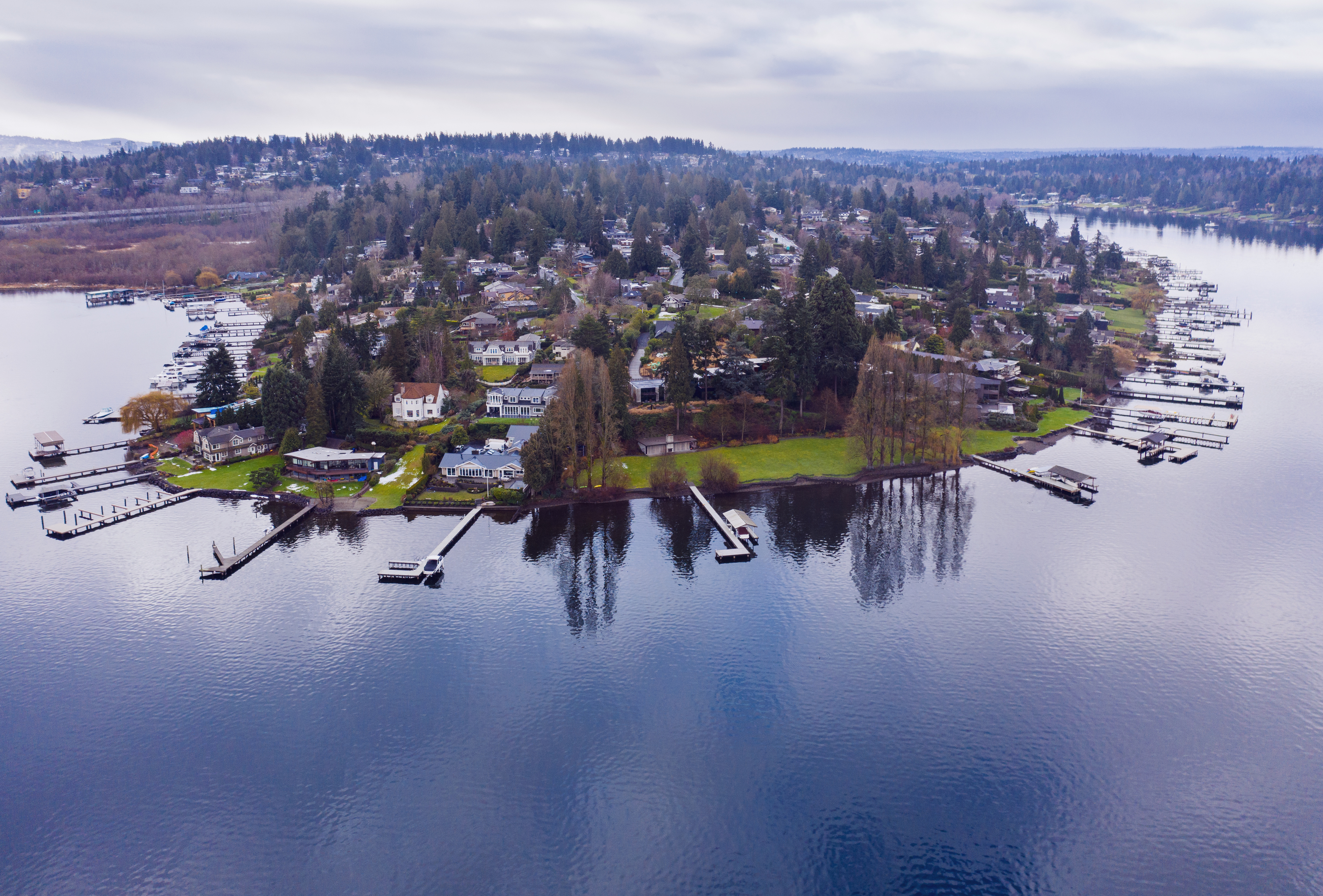
Medina occupies a peninsula that extends into Lake Washington between Meydenbauer Bay to the south and Fairweather Bay to the north, with Evergreen Point forming its western tip, the closest point on the Eastside to Seattle, connected by the SR-520 floating bridge. This geography is not incidental to Medina's character. It is the reason Medina exists as it does.
The shoreline here is unusually varied. Southern-exposure lots along the Meydenbauer corridor catch afternoon light from October through March, a material consideration when western Washington's overcast months determine how a home lives for half the year. The Evergreen Point properties, facing west and northwest, absorb the full drama of sunsets over the Olympic range. Northern parcels along Fairweather Bay are quieter, more sheltered, favored by owners who prioritize deep-water moorage over panoramic spectacle.
What unifies these micro-geographies is a tree canopy that has been carefully preserved, not by accident, but by a community that has historically resisted the clear-cutting impulse that transformed neighboring municipalities. Drive Medina's streets in August and the filtered light through mature Douglas fir and Western red cedar creates the feeling of a private forest that happens to contain some of the most valuable residential real estate in North America.
"Medina is not a suburb. It is a position, geographic, architectural, and cultural, that has been quietly defended for a century."
Medina's residential architecture spans nearly a century, from original Craftsman-era lake cottages, a few of which still stand along 78th Avenue NE, to the contemporary glass-and-steel compositions that have redefined the waterfront over the past two decades. But the spectrum is narrower than it appears. Medina has never been a place for architectural exhibitionism. Even the most ambitious new constructions tend toward restrained modernism: clean horizontal lines, extensive glazing oriented to the water, natural stone or cedar cladding that defers to the landscape rather than competing with it.
The reason is partly regulatory, Medina's building codes enforce strict setbacks, height limits, and tree-preservation requirements that constrain floor plates and push architects toward lateral, site-responsive designs rather than vertical statements. But it is equally cultural. The community's most established residents have historically preferred homes that reveal their quality through materiality and proportion rather than scale. A $25 million home on Evergreen Point may be invisible from the street. This is by design.
For buyers considering new construction or significant renovation, this context matters enormously. The permitting process in Medina is deliberate. Setback calculations from the ordinary high-water mark require survey-grade precision. Tree removal permits involve arborist review and, frequently, neighbor notification. Design review considers not just the structure itself but its relationship to the streetscape and sightlines from adjacent properties. Working with an advisor who understands these dynamics, and the key personnel at City Hall, can mean the difference between an 8-month timeline and a 24-month one.
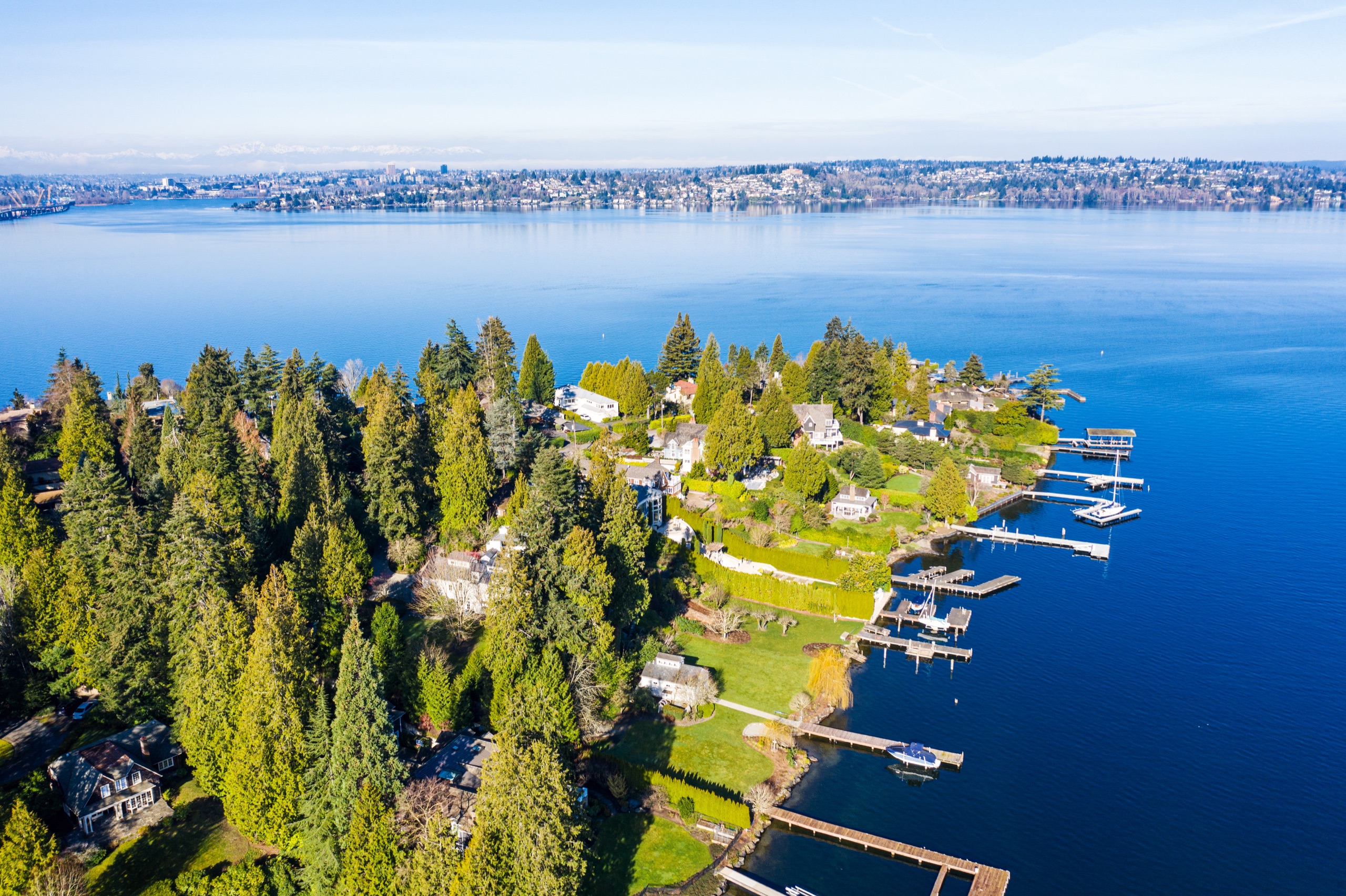
The western tip of the peninsula, Medina's most coveted address. Properties here command west-facing water views and proximity to the 520 bridge corridor. Lot sizes typically range from 0.5 to 2+ acres. Recent sales have exceeded $50M for prime waterfront parcels.
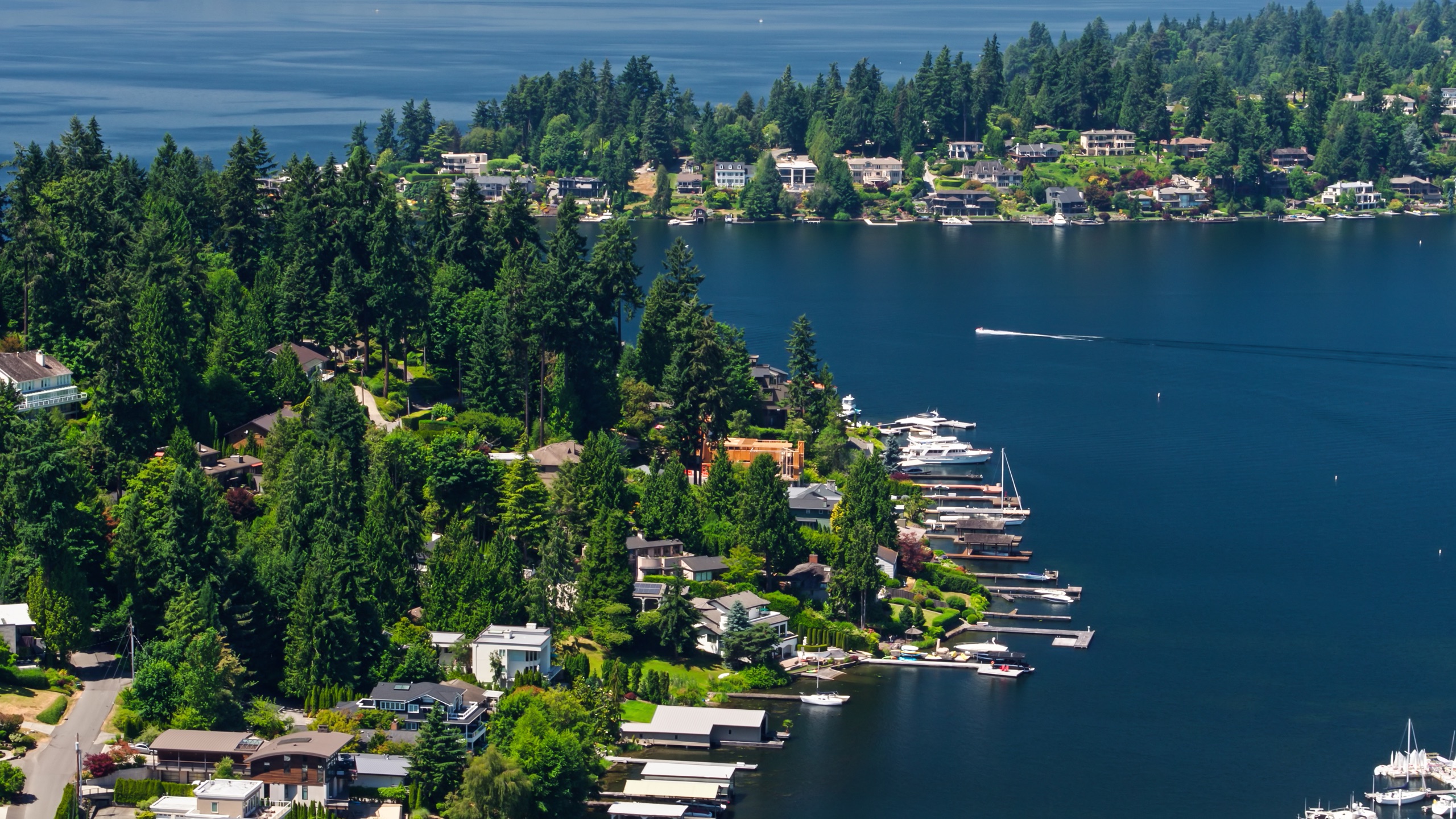
The southern shore, running from Meydenbauer Bay eastward toward Clyde Hill. South-facing exposure delivers the Eastside's best natural light. The neighborhood's proximity to downtown Bellevue, walkable in 15 minutes, adds a practical dimension that Evergreen Point's seclusion does not.
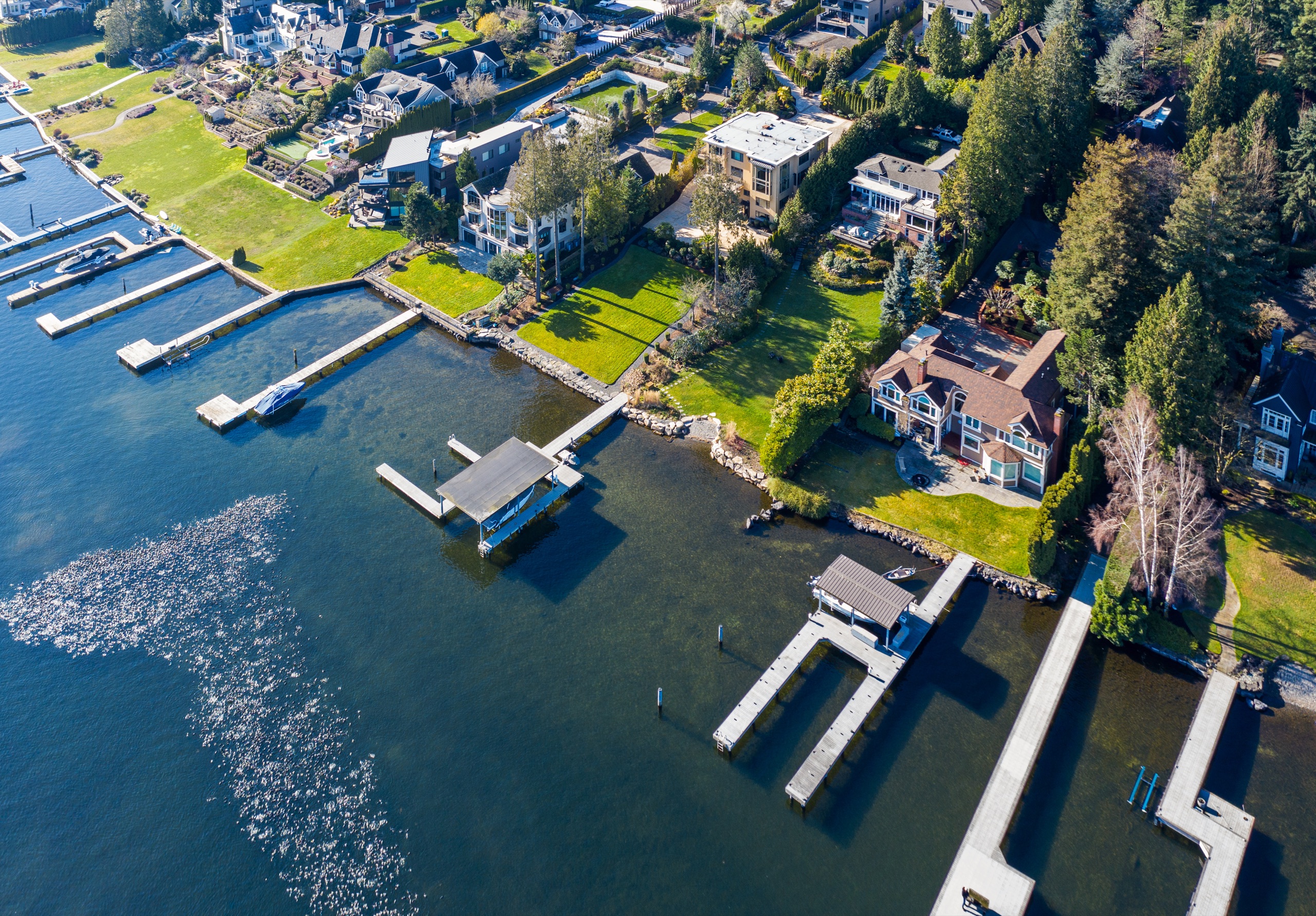
The quieter northern shore, where Medina meets the Yarrow Point border. Deep lots with mature landscaping. Several properties here include deep-water moorage suitable for vessels up to 60 feet. The trade-off is northern exposure, less direct sun, but unmatched privacy and calm water.
Medina has no commercial district. There are no restaurants, no coffee shops, no retail storefronts. This is not an oversight, it is a century-old zoning decision that the community has reaffirmed repeatedly. The effect is a residential purity that is increasingly rare in the metropolitan Puget Sound: the only structures you encounter on Medina's streets are homes, the Overlake Golf & Country Club, three parks, and two churches.
The schools question is typically the first one families raise. Medina is served by the Bellevue School District, consistently ranked among the top 1% nationally. Medina Elementary feeds into Chinook Middle School and Bellevue High School, a pipeline that families here describe as one of the community's most tangible assets. Private school families have proximity to Lakeside, University Prep, and the Eastside's growing constellation of independent schools, all within a 15-minute drive.
The practical rhythm of daily life is shaped by Medina's position between two commercial centers. Downtown Bellevue, with its Lincoln Square, Bellevue Square, and the rapidly expanding Main Street corridor, is a 5-minute drive east. Seattle's South Lake Union and Capitol Hill are 12 minutes west via 520. The bridge tolling, which once gave pause, has become a non-issue for most residents, simply part of the infrastructure cost of living at the intersection of two cities.
Drawn directly from NWMLS, updated continuously. Reflects closed residential transactions in the incorporated City of Medina.
For a deeper read of the market, including private transaction context and the mechanics behind the numbers, begin the conversation.
Whether you are evaluating a specific property or beginning to explore the community for the first time, a private consultation is the right starting point.
A short, quarterly note on the Eastside luxury market. New long-form pieces, market data shifts, and the occasional observation from the field. No more than four emails a year.
No spam. Unsubscribe anytime.